

Modular Homes in India: How the Build Process Works from Plot to Handover
The most common question asked about a modular home is not about steel, seismic performance or cost. It is simpler than that: what actually happens, in what order, and what is the homeowner responsible for along the way.
Conventional construction has a process everyone in India recognises, even when it goes badly. Modular construction runs on a different sequence, and the sequence itself is the reason the timelines differ.
Stage One: Plot Assessment and Feasibility
Before design begins, the plot is assessed for soil condition, access, levels, setbacks and local approval requirements. Access matters more in a modular build than in a conventional one, because finished components have to reach the site by road. A plot with a narrow approach or a tight turning radius changes how the structure is broken into transportable sections.
Homeowner responsibility at this stage is documentation: title, plot survey and any local authority approvals already in hand.
Stage Two: Design Finalisation
Layout, elevation, room configuration and finish specification are locked at this stage. This is the single most important gate in the entire programme, and it is where modular construction differs most from what buyers expect.
In conventional construction, changes are made on site throughout the build, absorbed as variations and paid for at the end. In a modular build, the design is frozen before manufacturing begins, because the components are produced to that specification. Changes after this point are expensive and disruptive in a way that changes on a conventional site are not.
Buyers who understand this gate get a faster, cleaner build. Buyers who treat design finalisation as provisional lose the timeline advantage they came for.
Stage Three: Parallel Manufacture and Foundation
This is where the timeline compresses. Foundation work proceeds on site while structural components are manufactured at the facility. The two run simultaneously rather than in sequence.
Every unit is produced under ISO 9001:2015 certified processes at registered manufacturing facilities. Structural and finish specification is controlled at the plant rather than through supervision after delivery.
Stage Four: Transport and Erection
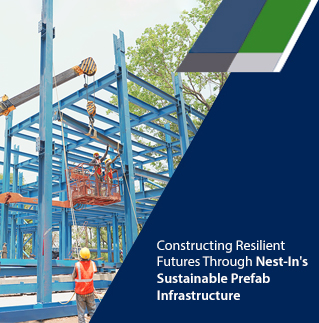
Components travel to site and are positioned onto the completed foundation. Site work at this stage is a contained programme with a smaller crew and a defined scope, which is why the site is open for a fraction of the duration a conventional build requires.
Structures are engineered to withstand earthquakes in Seismic Zones IV and V as per IS 1893, resist wind speeds up to 240 km/hr and provide fire resistance of up to 90 minutes.
Stage Five: Services, Finishing and Handover
Electrical and plumbing connections are made, finishes are completed and the house is commissioned. Snagging on a factory-built structure is narrower in scope, because the finish tolerance was set in controlled conditions rather than on an open site.
Where Delays Actually Originate
Delays in a modular residential build rarely come from manufacturing. They come from plot approvals that were not secured before design began, from design changes requested after the specification was frozen, and from site access constraints identified too late to plan around.
All three are manageable, and all three are decided in the first two stages rather than the last two.
Connect with us at 1800 208 8200 or visit www.nestin.co.in to book a plot feasibility assessment.
Sources
- Seismic zone classifications: IS 1893, Bureau of Indian Standards
- Quality management certification: ISO 9001:2015
Posted in Nestudio on Sep 18, 2026.




Contact Us
Recent Post
Adding a Floor to an Existing House: Why Vertical Extension Favours Light Gauge Steel
Disaster Response Infrastructure: Building for the Window Between Relief and Rehabilitation
Building Schools in the Districts Conventional Construction Cannot Reach
Defence Hangars: Why Large-Span Structures Decide How Fast a Base Becomes Operational
What a Prefabricated House Costs in India: A Buyer's Guide to the Cost Structure




















































































































































Add comment