

Why "How Much Does It Cost" Is the Question the Construction Industry Avoids
Ask a conventional construction contractor for a final price at the start of a project and the honest answer is usually a range, not a number. The construction industry has built an entire pricing culture around deferring the real cost conversation until well after a buyer has committed.
Why the Industry Avoids the Question
Bespoke, site-by-site quoting is normal in conventional construction. Material costs shift with market prices, labour costs shift with availability, and the final bill depends on decisions, and problems, that only surface once the project is underway. Projects that start within budget routinely exceed it by handover, and the gap is absorbed as an accepted cost of doing business rather than treated as a pricing failure.
This is not necessarily bad faith. It reflects a construction method where cost genuinely cannot be fixed in advance, because so much of the build depends on variables the contractor does not control. But it leaves the buyer carrying financial risk they were rarely told about clearly at the outset.
How Prefab Changes the Cost Conversation
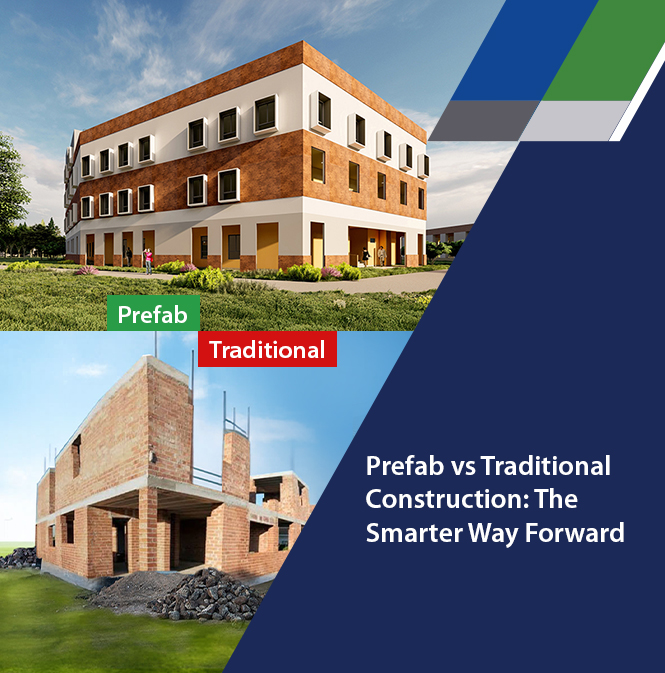
Factory manufacturing removes many of the variables that make conventional pricing unpredictable. Materials are procured in bulk across multiple projects rather than sourced site by site, and production runs on a factory schedule that weather and local labour availability do not disrupt. A modular unit's cost sits closer to a fixed specification than an open-ended estimate, because the manufacturing process it comes from does not change from project to project.
The cost conversation also needs to extend further than conventional pricing typically does. A building's financing cost over a shorter construction period, its maintenance demand, and its recoverable material value at end of life are all part of what a genuine cost comparison should include, not just the number quoted at tender.
What Buyers Actually Need to Understand
A headline per-square-foot figure answers only part of the pricing question. Buyers evaluating prefab construction should look for clarity on what a quoted price actually includes: foundation and site preparation work, transportation and site assembly, customisation beyond the standard specification, and the sanitation, electrical and finishing packages that some quotes bundle in and others do not. A lower headline number that excludes several of these is not a lower total cost. It is a different scope being compared against the wrong baseline.
The Real Estate (Regulation and Development) Act, 2016 (https://www.indiacode.nic.in/handle/123456789/2158) already mandates cost and delivery disclosure for developers selling flats and plotted developments above a defined scale. A buyer commissioning a custom home build with an individual contractor rarely works within a similarly regulated framework, which is exactly where the pricing conversation tends to become least transparent.
A Transparent, Buyer-First Approach
Tata Steel Nest-In's pricing conversation starts with a feasibility assessment specific to the plot, location and configuration a buyer actually needs, not a generic per-square-foot figure extended across every possible site condition. Every unit is manufactured under ISO 9001:2015-certified processes at registered manufacturing facilities, so the specification behind a quoted price is the same regardless of where in India it is delivered.
Conclusion
The question the construction industry has learned to defer is the one buyers most need answered early. A cost conversation that includes the full scope, and the full service life, of what is being built is not a harder conversation to have. It is simply a more honest one, and it is the conversation Nest-In is positioned to have from the first enquiry.
Connect with us at 1800 208 8200 or visit www.nestin.co.in to get your custom build estimate.
Sources
- Real estate cost and delivery disclosure regulation: Real Estate (Regulation and Development) Act, 2016, India Code (https://www.indiacode.nic.in/handle/123456789/2158)
- Quality management certification: ISO 9001:2015
Posted in Nest-In on Jul 25, 2026.




Contact Us
Recent Post
What a Prefabricated House Costs in India: A Buyer's Guide to the Cost Structure
EV Charging Infrastructure: Why the Structure Around the Charger Decides the Rollout Speed
Modular Homes in India: How the Build Process Works from Plot to Handover
Why Hospitals and Healthcare Facilities Are Being Built Modular
Portable Toilets and Modular Sanitation Units in India: A Complete Buyer’s Guide





















































































Add comment